
Comunicación accesible en el metaverso. Una revisión a la situación actual de las principales plataformas
En el contexto de la evolución de internet a su tercera generación, las plataformas del metaverso dejan en evidencia eventuales desigualdades que alimentan la brecha digital. Con base en esta premisa, se revisó el estado actual de la accesibilidad en los metaversos más populares para evaluar el nivel de inclusión digital en el ecosistema virtual. Se realizó un análisis comparativo de una muestra de diez plataformas, evaluando las características de accesibilidad visual, auditiva, del habla, motora y cognitiva basadas en los criterios de las Pautas de Accesibilidad al Contenido Web (WCAG). Los resultados revelan un panorama de accesibilidad fragmentado, caracterizado por la asimetría entre las plataformas centralizadas y descentralizadas. Los entornos centralizados, arraigados en mecánicas gamificadas, muestran unos estándares de accesibilidad reactiva superiores, especialmente para las discapacidades motoras y auditivas. Por el contrario, los metaversos descentralizados presentan deficiencias sistémicas debido a la rigidez de sus motores y arquitecturas propietarios, lo que se traduce en una falta de herramientas básicas de inclusión. La transición hacia una accesibilidad inteligente, adaptativa y nativa del motor gráfico será fundamental para salvar la brecha digital en la próxima generación de espacios virtuales y fomentar modelos y recursos de comunicación virtual más inclusivos.
Acceso al artículo completo / Access to the complete article
🟠
Integrating GAI in Metaverse: Positive and Ethical Use of Neo-NPCs in Branding Strategies
This study examines the use of non-player characters (NPCs) in metaverse marketing strategies, emphasizing their potential for immersive persuasion and user interaction, especially by brands and companies. This paper highlights how generative and multimodal artificial intelligence can transform NPCs into more sophisticated and adaptive tools (Neo-NPCs), enhancing the user experience by offering personalized and contextual interactions. Furthermore, it reviews technical and social challenges like data privacy and platform interoperability. It proposes future research on personalizing the user experience and the ethical implications of using advanced NPCs in marketing
Acceso al artículo completo / Access to the complete article
🟠
Realidad Extendida, Computación Espacial y Metaverso ¿instrumentos de marketing o evidencias de un cambio de paradigma en la comunicación?
La rápida evolución tecnológica está impulsando la virtualización en diversos campos, formando comunidades digitales específicas y estableciendo las bases para el metaverso. Los avances en tecnologías móviles, big data e inteligencia artificial están reconfigurando en muchos sentidos la vida humana. Se trata de un escenario que carece de uniformidad y que está determinado por las necesidades de los principales actores tecnológicos. Con la aparición de nuevas tecnologías y evolución de las existentes, se redefinen constantemente conceptos como el de Realidad Virtual,Realidad Aumentada y Realidad Mixta, originando otros como el de la Realidad Extendida y conviviendo en el mismo espacio-tiempo con propuestas como el Metaverso y ahora más recientemente, la Computación Espacial. Esto genera preguntas sobre la conveniencia o utilidad real de estos, sus principales diferencias y consideraciones principales, lo cual exige un mayor compromiso en torno a la alfabetización digital.
Acceso al artículo completo / Access to the complete article
🟠
Comunicación, globalidad e influencia en el metaverso: el caso asiático
Este trabajo muestra cómo desde Asia se ha asumido el metaverso como un nuevo canal de comunicación por parte de las administraciones gubernamentales. Se desarrolla una metodología consistente en un proceso de búsquedas digitales mediante términos clave ligados al ámbito del metaverso, gobernabilidad y comunicación. Finalmente, de todos los resultados obtenidos, la muestra consta de siete experiencias virtuales funcionales y operativas durante el primer semestre del año 2023. Los casos analizados son Metanesia (Indonesia), Metaverse Seoul (Corea del Sur), Metaverse Dubai (Dubai), Metaverse Thailand (Tailandia), ChangiVerse (Singapur), SentosaLand (Singapur) y MetaTokyo (Japón). Los principales resultados apuntan a una búsqueda por crear metaversos propios, lejos de plataformas existentes, la escasa intención de procurar experiencias inmersivas y la clara intencionalidad de recurrir a lo virtual para explotar la narrativa turística y de promoción de activos digitales.
Acceso al artículo completo / Access to the complete article
🟠
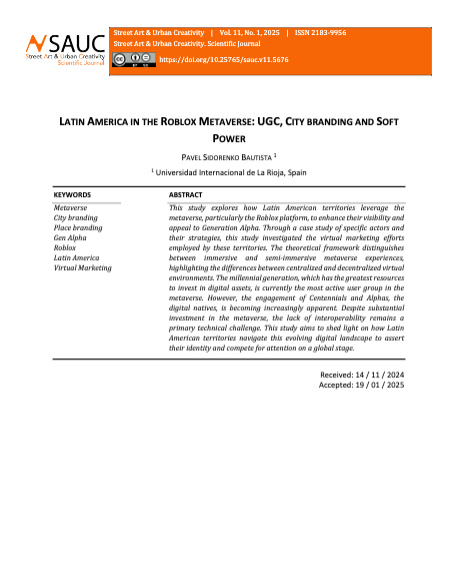
Latin America in the Roblox Metaverse: UGC, City Branding, and Soft Power
This study explores how Latin American territories leverage the metaverse, particularly the Roblox platform, to enhance their visibility and appeal to Generation Alpha. Through a case study of specific actors and their strategies, this study investigated the virtual marketing efforts employed by these territories. The theoretical framework distinguishes between immersive and semi-immersive metaverse experiences, highlighting the differences between centralized and decentralized virtual environments. The millennial generation, which has the greatest resources to invest in digital assets, is currently the most active user group in the metaverse. However, the engagement of Centennials and Alphas, the digital natives, is becoming increasingly apparent. Despite substantial investment in the metaverse, the lack of interoperability remains a primary technical challenge. This study aims to shed light on how Latin American territories navigate this evolving digital landscape to assert their identity and compete for attention on a global stage.
Acceso al artículo completo / Access to the complete article
🟠
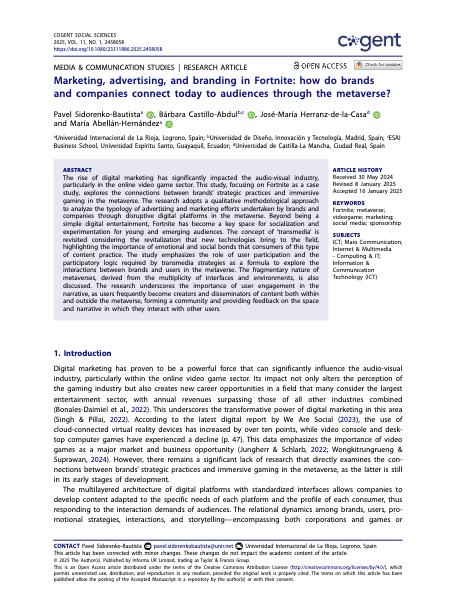
Marketing, advertising, and branding in Fortnite: how do brands and companies connect today to audiences through the metaverse?
The rise of digital marketing has significantly impacted the audio-visual industry, particularly in the online video game sector. This study, focusing on Fortnite as a case study, explores the connections between brands’ strategic practices and immersive gaming in the metaverse. The research adopts a qualitative methodological approach to analyze the typology of advertising and marketing efforts undertaken by brands and companies through disruptive digital platforms in the metaverse. Beyond being a simple digital entertainment, Fortnite has become a key space for socialization and experimentation for young and emerging audiences. The concept of ‘transmedia’ is revisited considering the revitalization that new technologies bring to the field, highlighting the importance of emotional and social bonds that consumers of this type of content practice. The study emphasizes the role of user participation and the participatory logic required by transmedia strategies as a formula to explore the interactions between brands and users in the metaverse. The fragmentary nature of metaverses, derived from the multiplicity of interfaces and environments, is also discussed. The research underscores the importance of user engagement in the narrative, as users frequently become creators and disseminators of content both within and outside the metaverse, forming a community and providing feedback on the space and narrative in which they interact with other users.
Acceso al artículo completo / Access to the complete article
🟠
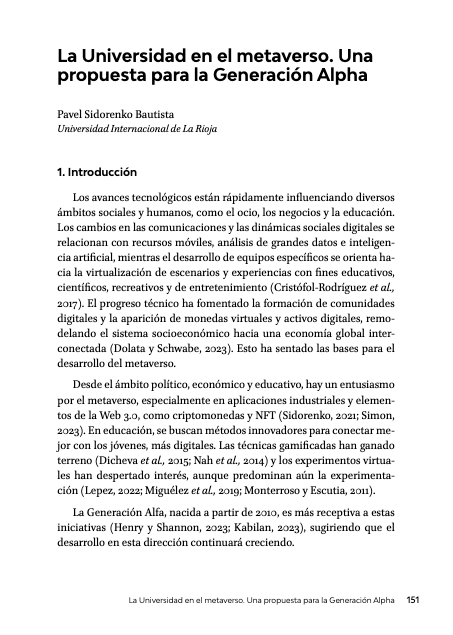
La Universidad en el metaverso. Una propuesta para la Generación Alpha
Acceso al artículo completo / Access to the complete article
🟠
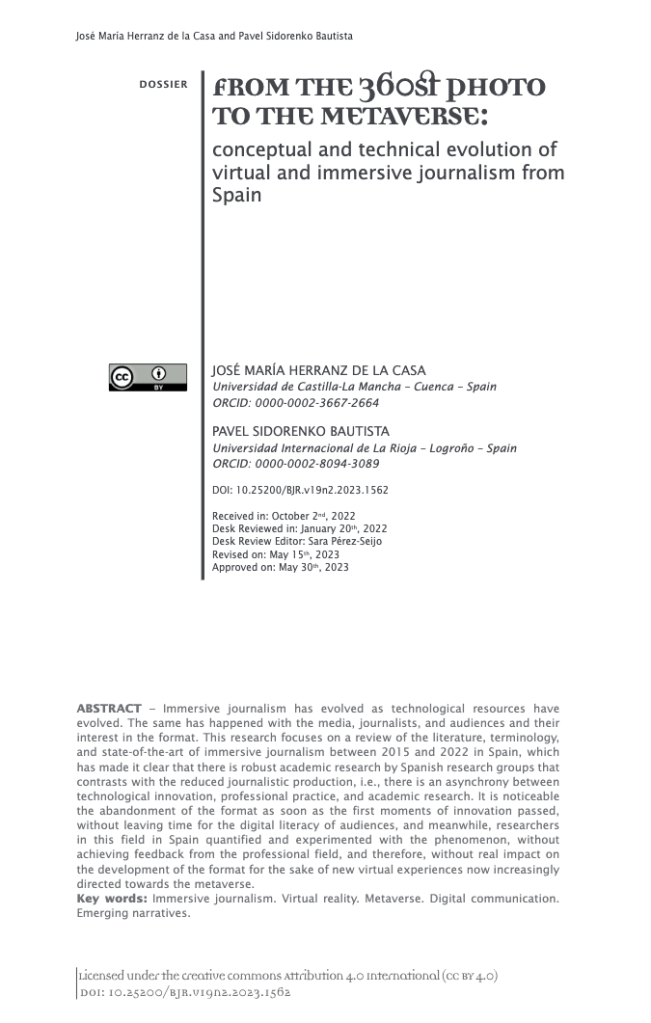
From the 360º photo to the Metaverse: Conceptual and Technical Evolution of Virtual and Immersive Journalism from Spain
Immersive journalism has evolved as technological resources have evolved. The same has happened with the media, journalists, and audiences and their interest in the format. This research focuses on a review of the literature, terminology, and state-of-the-art of immersive journalism between 2015 and 2022 in Spain, which has made it clear that there is robust academic research by Spanish research groups that contrasts with the reduced journalistic production, i.e., there is an asynchrony between technological innovation, professional practice, and academic research. It is noticeable the abandonment of the format as soon as the first moments of innovation passed, without leaving time for the digital literacy of audiences, and meanwhile, researchers in this field in Spain quantified and experimented with the phenomenon, without achieving feedback from the professional field, and therefore, without real impact on the development of the format for the sake of new virtual experiences now increasingly directed towards the metaverse
🟠
City Branding and Place Branding in the Metaverse: how real cities build their virtual image and how virtual cities do it
Although the concept of the Metaverse dates back to the end of the 20th century and the first open platforms to the first decade of the 21st century with cases such as Second Life or Roblox, today it has gained much celebrity and transcended the media because of the structural changes of the now-defunct Facebook Corporation (now «Meta»), as well as Epic Games, parents of the popular Fortnite. It is worth mentioning that the remarkable evolution of connections, mobile technologies, and greater digital literacy on a global scale has made this type of initiative more relevant today.
The technological field has expressed its intention to move towards the development of virtual spaces that serve as a social, productive, and recreational extension of individuals, considering three fundamental elements: interactivity, corporeality, and persistence. The initiatives are being very diverse, posing an important range of categories and options from closed environments, directly controlled by companies (as is the case today with the most popular social networks) to other decentralized and more open ones based on the block chain.
Regardless of their quality or category, these metaverses propose, as they have been doing since the first decade of the 21st century, a privileged space for creativity and contact with new user segments, but, above all, for the evolution of dialogues in digital environments. Since the early days of Second Life, it has been possible to see how brands, companies, institutions, and professionals of all kinds have carried out projects in which they have not only transferred real-life experiences but have raised others natively in these virtual scenarios, thus reaffirming an innovative attitude.
Like these actors, cities have expressed their intention to continue pushing and advancing in their public diplomacy processes by entering these platforms through functional replicas, where individuals not only relate to each other but can learn more about these cities, get in touch with them, with their services and heritage offer, in addition to offering activities and services native to the environment. However, there has also been the phenomenon of the construction and development of «cities» or «settlements» of the Metaverse, with very particular aesthetics and synergies, especially in decentralized proposals on block-chain systems such as Decentraland or The Sandbox.
Thus, this research aims to study how the concepts of ‘place branding’ and ‘city branding’ are approached with a focus on the Metaverse and from the Metaverse itself: differences, similarities, particularities, determining elements, and projections. Through a comparative analysis, it will be possible to know how this incipient process is faced from the communication point of view, as well as a possible rethinking of the concept of the city. The results point to few experiences now, where in some cases the goal is to develop digital thematic extensions of strategic areas of real cities, while others are erected natively in this virtual scenario.

🟠
Tecnología, comunicación digital y discursos urbanos: las ciudades del metaverso

🟠
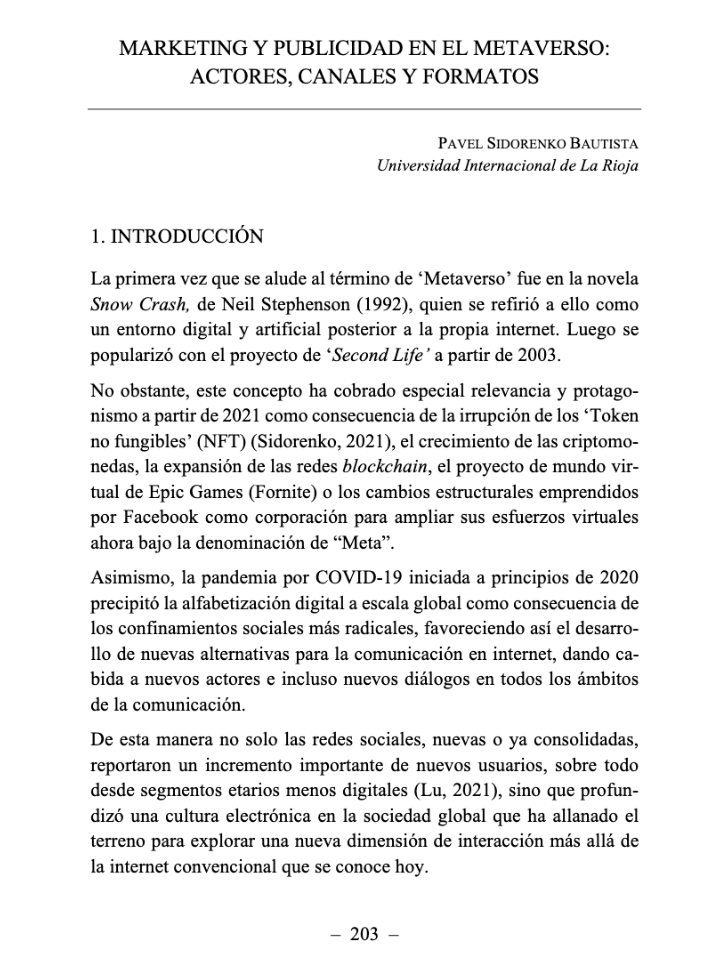
Marketing y Publicidad en el Metaverso: actores, canales y formatos
Aunque el término Metaverso no es nuevo y probado de la ciencia ficción, sí que resulta un terreno virgen y privilegiado para que marcas y empresas exploren y desarrollen un nuevo modelo de comunicación más inmersivo, más interactivo y sobre todo, que procure un alcance hacia nuevos segmentos de público y refuerzan la relación con los más digitales ¿cuáles son los actores más aventajados, qué opciones son las mejores en este momento incipiente?
⬇️
PUBLICACIONES DE CARÁCTER DIVULGATIVO SOBRE EL METAVERSO


 pavelsidorenko.com