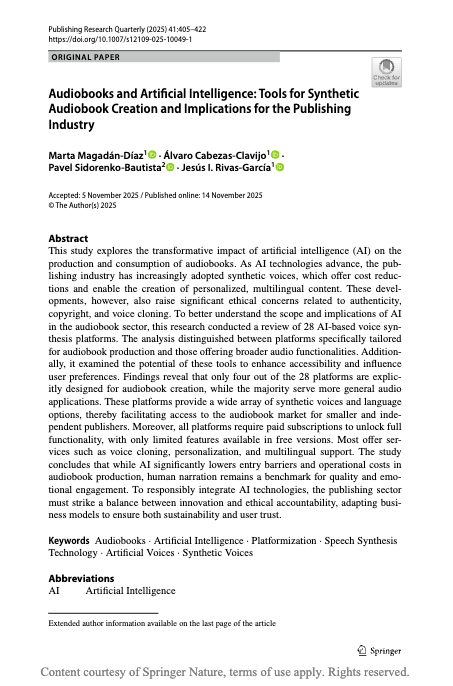
Audiobooks and Artificial Intelligence: Tools for Synthetic Audiobook Creation and Implications for the Publishing Industry
his study explores the transformative impact of artificial intelligence (AI) on the production and consumption of audiobooks. As AI technologies advance, the publishing industry has increasingly adopted synthetic voices, which offer cost reductions and enable the creation of personalized, multilingual content. These developments, however, also raise significant ethical concerns related to authenticity, copyright, and voice cloning. To better understand the scope and implications of AI in the audiobook sector, this research conducted a review of 28 AI-based voice synthesis platforms. The analysis distinguished between platforms specifically tailored for audiobook production and those offering broader audio functionalities. Additionally, it examined the potential of these tools to enhance accessibility and influence user preferences. Findings reveal that only four out of the 28 platforms are explicitly designed for audiobook creation, while the majority serve more general audio applications. These platforms provide a wide array of synthetic voices and language options, thereby facilitating access to the audiobook market for smaller and independent publishers. Moreover, all platforms require paid subscriptions to unlock full functionality, with only limited features available in free versions. Most offer services such as voice cloning, personalization, and multilingual support. The study concludes that while AI significantly lowers entry barriers and operational costs in audiobook production, human narration remains a benchmark for quality and emotional engagement. To responsibly integrate AI technologies, the publishing sector must strike a balance between innovation and ethical accountability, adapting business models to ensure both sustainability and user trust.
Acceso al artículo completo / Access to the complete article

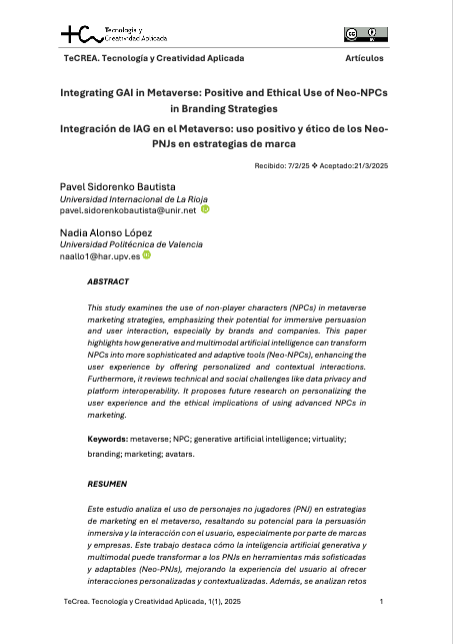
Integrating GAI in Metaverse: Positive and Ethical Use of Neo-NPCs in Branding Strategies
This study examines the use of non-player characters (NPCs) in metaverse marketing strategies, emphasizing their potential for immersive persuasion and user interaction, especially by brands and companies. This paper highlights how generative and multimodal artificial intelligence can transform NPCs into more sophisticated and adaptive tools (Neo-NPCs), enhancing the user experience by offering personalized and contextual interactions. Furthermore, it reviews technical and social challenges like data privacy and platform interoperability. It proposes future research on personalizing the user experience and the ethical implications of using advanced NPCs in marketing
Acceso al artículo completo / Access to the complete article
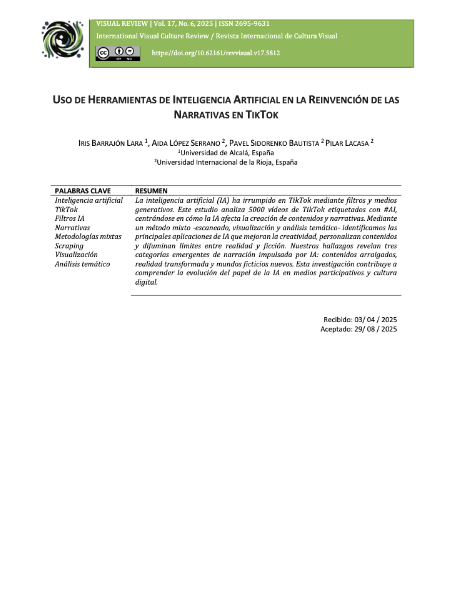
Uso de herramientas de inteligencia artificial en la reinvención de las narrativas en TikTok
La inteligencia artificial (IA) ha irrumpido en TikTok mediante filtros y medios generativos. Este estudio analiza 5000 vídeos de TikTok etiquetados con #AI, centrándose en cómo la IA afecta la creación de contenidos y narrativas. Mediante un método mixto -escaneado, visualización y análisis temático- identificamos las principales aplicaciones de IA que mejoran la creatividad, personalizan contenidos y difuminan límites entre realidad y ficción. Nuestros hallazgos revelan tres categorías emergentes de narración impulsada por IA: contenidos arraigados, realidad transformada y mundos ficticios nuevos. Esta investigación contribuye a comprender la evolución del papel de la IA en medios participativos y cultura digital.
Acceso al artículo completo / Access to the complete article
TikTok y la Inteligencia Artificial
Este libro nace con la intención de abrir una conversación crítica y creativa sobre el uso de la inteligencia artificial en TikTok, una de las plataformas más influyentes entre la juventud actual. El contenido que aquí se presenta tiene como objetivo contribuir al desarrollo de la alfabetización digital, poniendo el foco en esta red social como escenario clave para reflexionar sobre cómo se produce, consume y aprende en el entorno digital. El volumen es resultado de una investigación impulsada por el Vicerrectorado de Transferencia de UNIR, en la que han participado investigadoras e investigadores del grupo ‘Vidas Digitales’. A lo largo del proceso, se han analizado cientos de vídeos de TikTok utilizando técnicas de scraping automatizado mediante Apify. Esta herramienta ha permitido descargar y examinar métricas vinculadas a trece núcleos temáticos sobre inteligencia artificial, organizados a partir de hashtags relevantes. Gracias a este análisis, se seleccionaron ejemplos reales que ilustran de forma concreta los fenómenos abordados en cada capítulo. Los siete capítulos que componen esta obra pueden leerse de forma independiente y en cualquier orden. Cada uno de ellos aborda una dimensión distinta del impacto de la inteligencia artificial en TikTok, desde la personalización del contenido y la privacidad, hasta la autoimagen, la creatividad o la desinformación. Además, incluyen actividades pensadas para ser adaptadas a diversos contextos educativos, así como recursos adicionales para continuar explorando los temas tratados.
Acceso al artículo completo / Access to the complete article
Assessing the performance of 8 AI chatbots in bibliographic reference retrieval: Grok and DeepSeek outperform ChatGPT, but none are fully accurate
This study analyzes the performance of eight generative artificial intelligence chatbots — ChatGPT, Claude, Copilot, DeepSeek, Gemini, Grok, Le Chat, and Perplexity — in their free versions, in the task of generating academic bibliographic references within the university context. A total of 400 references were evaluated across the five major areas of knowledge (Health, Engineering, Experimental Sciences, Social Sciences, and Humanities), based on a standardized prompt. Each reference was assessed according to five key components (authorship, year, title, source, and location), along with document type, publication age, and error count. The results show that only 26.5% of the references were fully correct, 33.8% partially correct, and 39.8% were either erroneous or entirely fabricated. Grok and DeepSeek stood out as the only chatbots that did not generate false references, while Copilot, Perplexity, and Claude exhibited the highest hallucination rates. Furthermore, the chatbots showed a greater tendency to generate book references over journal articles, although the latter had a significantly higher fabrication rate. A high degree of overlap was also detected among the sources provided by several models, particularly between DeepSeek, Grok, Gemini, and ChatGPT. These findings reveal structural limitations in current AI models, highlight the risks of uncritical use by students, and underscore the need to strengthen information and critical literacy about AI tools in higher education.
Acceso al artículo completo / Access to the complete article
La inteligencia artificial generativa (IAG) en las bibliotecas y centros de documentación: una propuesta de estrategias y buenos usos
La Inteligencia Artificial Generativa (IAG) propone una revolución en el trabajo de las bibliotecas y centros de documentación, facilitando la creación autónoma de contenido y mejorando la productividad, la eficiencia y la experiencia del usuario.Herramientas como ChatGPT destacan en este ámbito, aunque plantean retos éticos y de privacidad. Es crucial fomentar un uso responsable de la IAG, así como mejorar la alfabetización digital de los usuarios mediante ‘prompts’ claros y específicos para obtener resultados óptimos. Además, la implementación de chatbots y otros recursos basados en IA para brindar asistencia en consultas y recomendaciones de libros es cada vez más común. Sin embargo, es esencial educar tanto al personal bibliotecario como a los usuarios sobre las capacidades y el uso adecuado de estas tecnologías. La adopción de la IA en bibliotecas sugiere la necesidad de laboratorios de innovación y manuales de buenas prácticas para enfrentar los desafíos éticos y sociales, y así asegurar una evolución positiva en el sector.
Acceso al artículo completo / Access to the complete article
The impact of ChatGPT on journalism : social listening, bibliographic production, and media agenda
Considering the powerful emergence of ChatGPT in society at large and in journalism in particular, this study aims to quantify the impact of ChatGPT on journalism from the perspective of news generation on this topic, its repercussions on social networks, and its impact on the academic sphere. — Methodology: This study quantitatively analyses the impact of ChatGPT on journalism from its launch on 30 November 2022 to 18 November 2023. It examines news coverage, Wikipedia visits, social media posts (Facebook, Instagram, and X), and academic output. Data was collected from Media Cloud, Wikipedia, and Proquest. — Results were generated in Flourish Studio, and analysis included normalization of records to avoid duplicates and ensure relevance to scholarly output. Results: The analysis of diverse documents underscores the versatility of the technology and the growing intersection between automation and journalistic writing. The study anticipates a future of increased human-machine collaboration in journalism. Key findings indicate widespread global coverage of the topic, reflecting a commensurate audience interest, as evidenced by internet search logs and social conversations.
Acceso al artículo completo / Access to the complete article
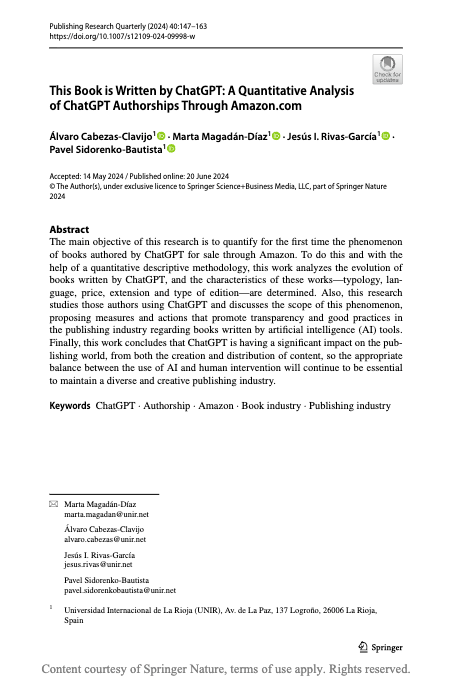
This Book is Written by ChatGPT: A Quantitative Analysis of ChatGPT Authorships Through Amazon.com
The main objective of this research is to quantify for the first time the phenomenon of books authored by ChatGPT for sale through Amazon. To do this and with the help of a quantitative descriptive methodology, this work analyzes the evolution of books written by ChatGPT, and the characteristics of these works—typology, language, price, extension and type of edition—are determined. Also, this research studies those authors using ChatGPT and discusses the scope of this phenomenon, proposing measures and actions that promote transparency and good practices in the publishing industry regarding books written by artificial intelligence (AI) tools. Finally, this work concludes that ChatGPT is having a significant impact on the publishing world, from both the creation and distribution of content, so the appropriate balance between the use of AI and human intervention will continue to be essential to maintain a diverse and creative publishing industry.
Acceso al artículo completo / Access to the complete article
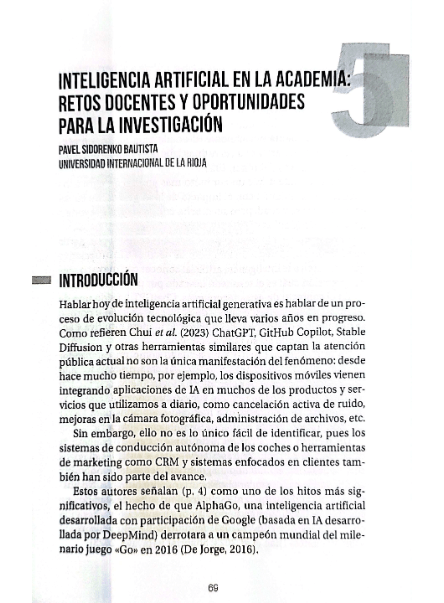
Inteligencia artificial en la academia: retos docentes y oportunidades para la investigación
Acceso al artículo completo / Access to the complete article
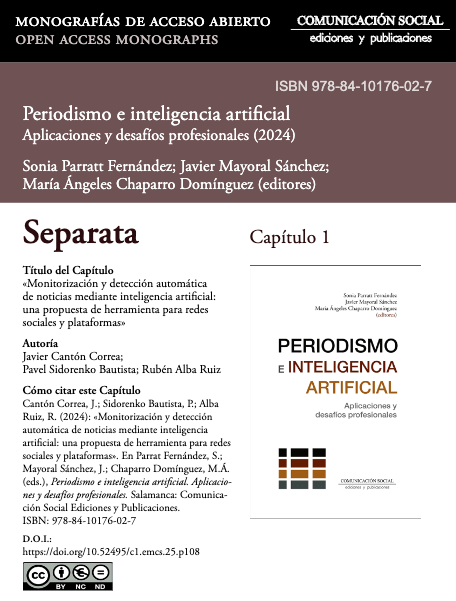
Monitorización y detección automática de noticias mediante inteligencia artificial: una propuesta de herramienta para redes sociales y plataformas
El capítulo introduce la integración de la inteligencia artificial (IA) en el periodismo, destacando innovaciones históricas y subrayando la necesidad de nuevas herramientas frente a retos actuales. Explora cómo las redacciones han adoptado la IA en diferentes procesos, señalando un enfoque generalizado en lugar de uno exclusivamente periodístico. Mediante el análisis comparativo de herramientas como Dataminr, NewsWhip y Factmata, se identifica un nicho para una herramienta centrada puramente en el periodismo. Se presenta NewsDetectorAI como una propuesta teórica, delineando su diseño, arquitectura y funcionalidades clave para abordar de manera efectiva las demandas del sector periodístico. La conclusión enfatiza el potencial innovador y de código abierto de NewsDetectorAI, remarcando su estado como propuesta no desarrollada que aspira a revolucionar la monitorización de noticias en la era digital.
Acceso al artículo completo / Access to the complete article
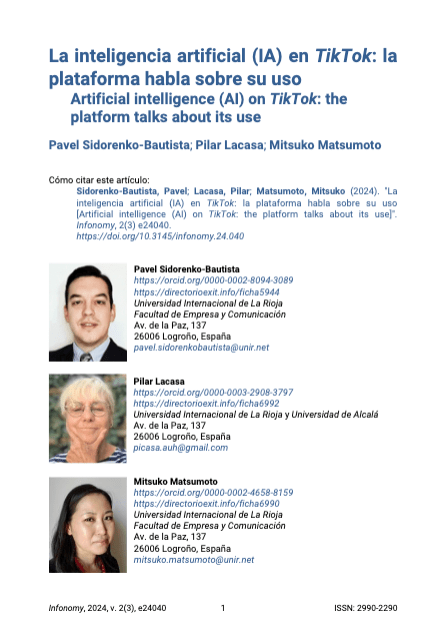
La inteligencia artificial (IA) en TikTok: la plataforma habla sobre su uso
Hoy TikTok está entre las plataformas más utilizadas a escala global. La utilización de la IA por parte de TikTok está estrechamente ligada a su éxito. Esta idea está presente en sus usuarios intuitivamente, aunque TikTok es opaco cuando explica cómo la utiliza. En este trabajo profundizamos sobre lo que TikTok nos dice acerca de cómo se usan las funcionalidades que aporta la IA. Se han consultado sus Web y también se ha preguntado sobre estas cuestiones al bot insertado en el Creative Center de TikTok, que forma parte de su Business Center. Los resultados muestran que TikTok no es completamente transparente al hablar del algoritmo que dirige el “para ti”. Sin embargo, reconoce el uso de la IA generativa en la creación de contenidos, en colaboración con otras herramientas asociadas como CapCut
Acceso al artículo completo / Access to the complete article
Neuromarketing e Inteligencia Artificial: el caso de la campaña ‘Con Mucho Acento’ de Cruzcampo
Desde que la neurociencia irrumpiera en el ámbito del marketing a principios del siglo XXI, se ha comprobado que los consumidores basan buena parte de sus decisiones cotidianas en sus sentimientos, en base a estímulos que les mueven emocionalmente, dejando de lado la parte consciente y racional. La investigación presenta un análisis de caso de un Spot premiado por su alcance y que utiliza la inteligencia artificial como base de la idea creativa, con el objetivo de comprobar en qué medida el uso de este recurso resulta relevante para generar emociones y afecta al recuerdo de marca, a la percepción de marca y a la promoción de una actitud positiva hacia esta. Para el análisis se ha utilizado una técnica de neuromarketing, elTest de Asociación Implícita, complementada con entrevistas en profundidad y una encuesta CAWI. Los resultados sugieren que el uso de la IA en la creación de mensajes publicitarios favorece la generación de actitudes positivas hacia la marca ya que potencia la fuerza del mensaje transmitido, pero no parece influir en la imagen de marca ni en la intención de consumo de esta.
Acceso al artículo completo / Access to the complete article
 pavelsidorenko.com